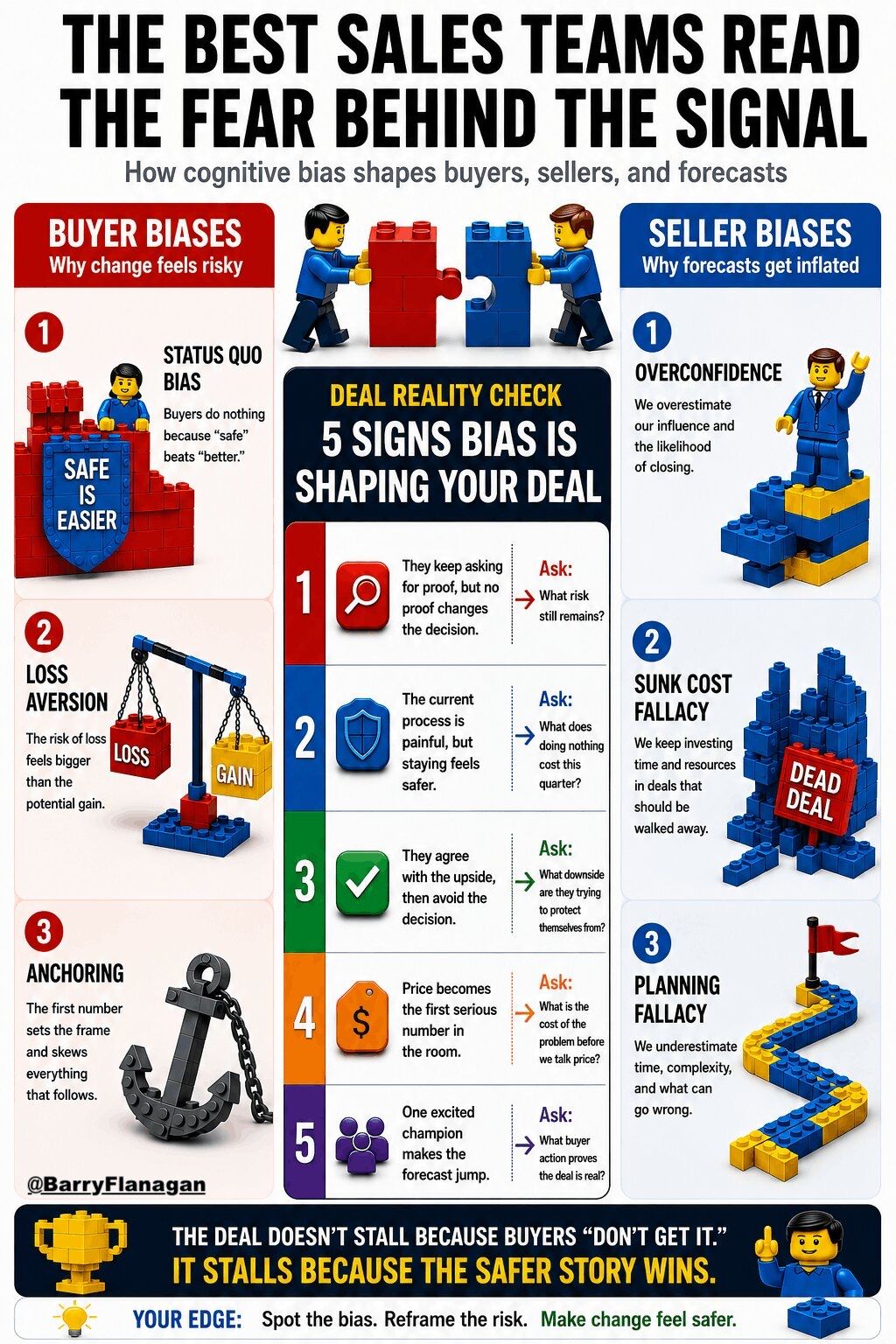
The best sales teams read the fear behind the signal
The best sales teams read the fear behind the signal. Cognitive bias shows when a proof request is really a risk request.
When a next step is only politeness.
When your forecast is moving faster than the buyer. Here’s the part sales training rarely explains.
A buying committee is not only asking: “Is this the right product?”
They are asking: “What happens to us if this goes wrong?”
That question changes the deal. The buyer is judging the career risk of choosing you. By the time most sellers notice, the deal has started drifting.
The buyer replies.
The champion sounds positive. The next meeting gets booked. But nothing real changes.
Save this before you mistake activity for commitment.
5 ways to notice cognitive bias is shaping your deal:
-
The buyer keeps asking for proof, but no proof changes the deal. ↳ Ask what risk must be removed before they can act.
-
The current process is painful, but staying feels safer. ↳ Put a number against the cost of doing nothing this quarter.
-
The buyer agrees with the upside, then avoids the decision. ↳ Show how the new path protects them from downside.
-
Your price becomes the first serious number in the room. ↳ Anchor the deal around the cost of the problem before your price.
-
One excited champion makes your forecast jump. ↳ Look for buyer action: budget, stakeholders, dates, internal pressure.
The hard part is that sellers have biases too.
One good call. One clean demo. One positive message from the champion.
Then the opportunity feels more advanced than it is.
I have seen teams do this for years.
They confuse energy with movement. Agreement with urgency. A champion with a decision process.
Then the deal slips.
The product may be right. The business case may be clear. But the risk was never clear enough.
You have seen this in your own pipeline.
You call it procurement delay. You call it needing one more stakeholder. You call it timing.
Sometimes that is true.
Before you diagnose your next stalled deal, ask: “Which risk is the buyer trying to avoid?”
If you cannot answer that, more information will not save the deal. Late-stage deals are won when doing nothing starts to look like the bigger risk.
Repost for a friend who’s calling it timing. Follow @BarryFlanagan to spot deal risk before your forecast gets ahead of the buyer.