When a business person stops pushing, it is not always
When a business person stops pushing, it is not always burnout. Sometimes they have stopped seeing effort change outcomes.
The sales lead stops following up after too many dead replies.
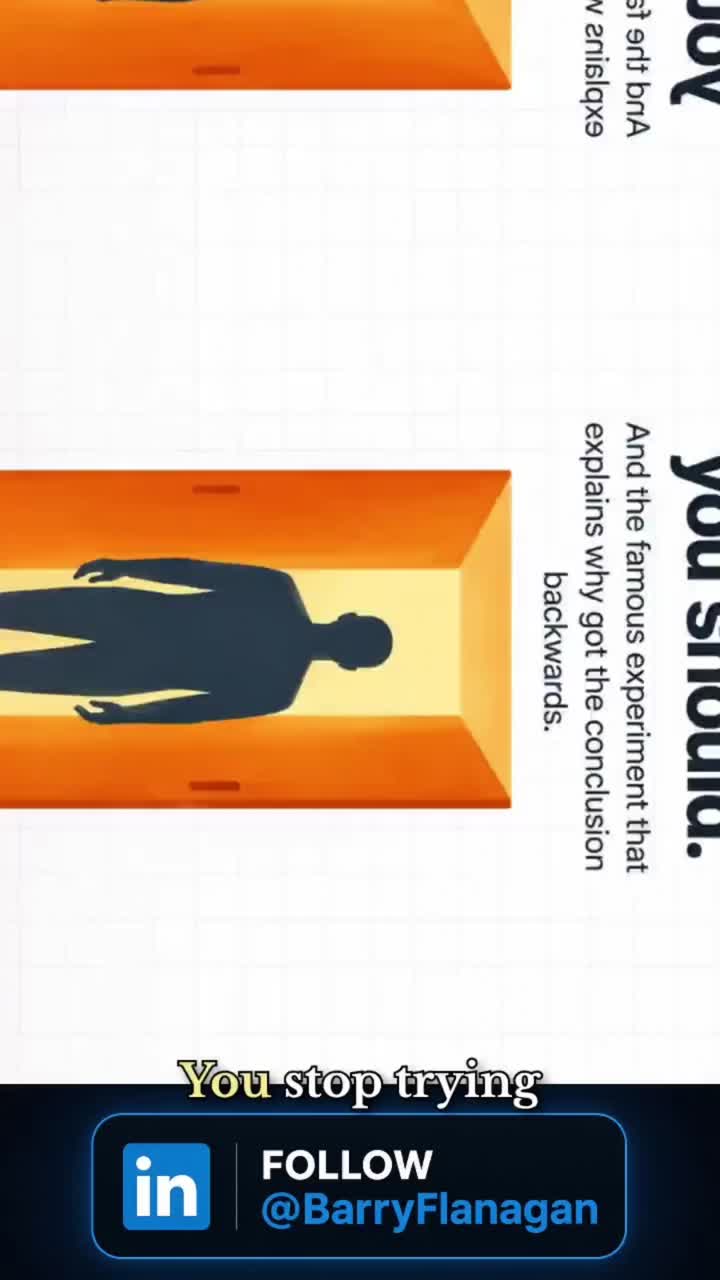
The manager stops raising the issue after three ignored meetings. The founder stops asking for help because the last 5 asks went nowhere. That is like the dog & the barrier in the video.
The escape may be there now.
But the body remembers when moving did nothing. That is learned helplessness.
It isn’t a character flaw. It happens when action stops changing what comes next.
By the time you notice it… You are already saving energy.
Save this before you mistake self protection for laziness.
5 ways learned helplessness shows up in your work:
-
You delay the proposal, pitch, or project you once wanted to win. ↳ Shrink it until one useful step can be finished today.
-
You assume the answer will be no before you ask. ↳ Make one clean request & watch what happens.
-
You stop raising the same issue because nothing changed last time. ↳ Name one part your action can still touch.
-
You wait for a perfect read of the room before making a call. ↳ Choose one reversible action with a clear result.
-
You confuse being drained with being powerless. ↳ Rest first, then test the smallest possible effort.
The hard part is that giving up can feel rational.
I have done it too. I stayed quiet. I delayed.
I called it being practical. But sometimes practicality hides the pain of trying again.
In 1967, Seligman & Maier ran an experiment that made learned helplessness famous.
Dogs under uncontrollable stress later failed to escape.
Decades later, the reframe became more useful. Passivity may be the default under stress. Control is what has to be learned.
That changes the fix.
A louder pep talk will not usually help. More pressure will not usually help. You need one small proof that action still changes the result.
One follow-up sent. One honest question asked. One task finished.
One visible win that says “What I did mattered.”
So before you judge yourself for stopping, ask a better question. Where did you stop seeing effort change outcomes?
Start there. One action. One result.
One reminder that your effort still touches the world. The barrier may be lower than it feels. First, your brain needs proof that jumping still works.
♻️ Repost for a friend who’s mistaken self-protection for laziness. 🔔 Follow Barry Flanagan to rebuild the proof that effort still matters.